Tuesday, March 8, 2011

Best Doric/Baroque Temple/Duomo So Far

Although Ortigia is nice enough in itself, our real goal was to see its Duomo, a Baroque cathedral built right on top of and unabashedly incorporating the foundations and columns of a 5th century BCE Doric Temple of Athena. It was pretty incredible.
North side of the building, note the inset Doric column, then
note the 10 or 12 more capitals along the top of the stone


Entrance and facade; pretty Baroque


Column hugger; inside, the massive 2500
year old columns are pretty conspicuous and
are still holding the thing up; one sees
religious buildings built over others all over
the more contested parts of Europe--the few
Roman temples that have survived in Rome
have done so because, like this Duomo, they
were "converted" to Christian use; but there
is nothing else of this age, intactness, and
continuing function


E.g.


Back to the Baroque


Doric columns at the head of what was the
cella


More columns


Looking off into one of the Baroque side
chapels


Ceiling of another


Play of light on the porch


Bonus: right down the Duomo Square, which
is significant for other architectural reasons,
is the Church of Santa Lucia (patron saint of
Sircusa), in which resides a moderately
famous Caravaggio, namely, his Santa Lucia,
which he painted while on the lam between
his flight from Malta and return to Italy 


The Church has a no pix policy, and while the
guard was enforcing this with a group of
college-age tourists, I snapped what is truly a
Parthian Shot as I was walking out the door;
evidently, this is not one of the paintings on
which Caravaggio's reputation stands, being
largely a butt-shot of one of the grave
diggers...

Monday, March 7, 2011

Ortigia

The island Ortigia was the original site of the Greek colony; now it is a beautifully-preserved little Medieval/Baroque city, part residential, part up-scale shops and restaurants. From the archaeological park we decided to walk to Ortigia--alas, it ended up being an 11 mile day of walking all-told--but it was rewarding enough. Bus tickets were sold out by evening, but the nice bus driver gave us a lift back to the campground anyway.

You have to love a place where a whole
pizza is just 75 cents, even frozen


Pinocchio store (Stromboli is not far away)


One of the bridges connecting Ortigia


More kids in costumes


Remains of Temple of Apollo


Street scene


Ablution area of synagogue; Jews were exiled in 1492


Balcony scene


Looking southwest over the bay


32 flavors--Hercules would have been proud


Peeking into someone's garage


Another alley

Siracusa's Archaeological Park

Siracusa has an interesting lay-out. The original colony was the island of Ortigia. A couple miles inland is another part of the ancient city, now the archaeological park, which houses the quarries, the amphitheater, the Greek theater, and more. The Park is about 700 meters beyond the the Orsi Museum.

Temple and altar remains


Another Greek theatre; is anyone keeping count?


Yes, but, you see, this one is different; whereas all the others
were built-up, this one was dug-out of the huge limestone
shelf that makes up the area


Waterfall in a little grotto near the theatre


The Ear of Dionysius, so named by Caravaggio (it's a long
story), a huge artificial grotto in the quarries


In the Ear, Vicki poses for scale


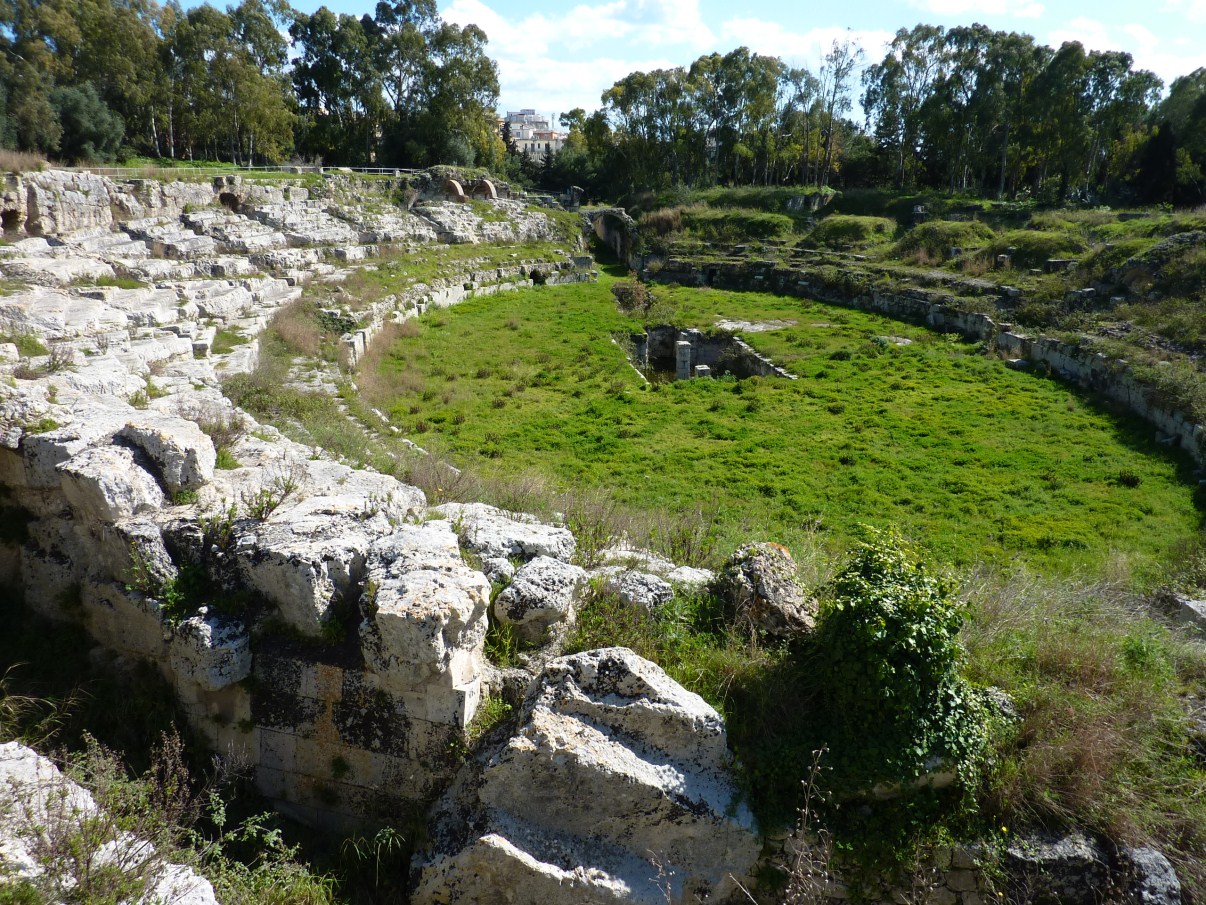
Roman amphitheatre


Alas, the photo can do little justice, but, 30 or
40 feet below rises one of the largest and
most interesting banyan trees I have seen


Eureka! Well, close, maybe; according to the map, the tomb
of Archimedes was supposed to be around here somewhere,
but we never found it, exactly; he was a Siracusan

Paolo Orsi Archaeological Museum in Siracusa

Sunday we drove on to the ancient Greek city of Siracusa, for a big day at the museum, the archaeological park, the medieval city, and the best Doric/Baroque temple/cathedral so far. Siracusa was settled by Greeks from Corinth in the mid-8th century BCE. And was said by some to rival Athens in its splendor. The museum's collection seemed to emphasize the everyday rather than the monumental, which was fine with us.
Entrance to the Paolo Orsi; Orsi was a regional archaeologist responsible for 
many of the area's important finds; it is a beautiful, new, capacious complex, 
already getting filled up...


The Orsi's particular strength, we thought, was in its paleo- and neolithic 
collections; the Greeks were not the first to settle here; above is a beautifully-
perfect 4th millennium BCE cup


Other neolithic pottery of unknown use--but interesting to speculate about


Just a smidge of the neolithic collection


Bone totem sticks, 2nd-3rd millenium BCE


Other devices of unknown use


And still more neolithic stuff


Gorgon image from one of the Greek temples in Siracusa; wait a second...
didn't we see this guy in a museum in Auckland?!


Votive City; hundreds of votive figures from the Temple of Ceres (or was it 
Demeter?), all carrying bundles of grain or even baked breads

Etna

I got up early Sunday morning for some pix of Etna, on whose northeastern slopes we are parked. It had clouded up by mid-morning every other day we have been here, so I figured this was my big chance.

So there it is, from our campground more or less


Closer-up, you can see a plume from one of its four summit
craters


Closer-up still


On down the road to Siracusa; I was getting concerned
about the black river of lava on the left there


But the barista at the service area assured me there was no
cause for alarm; Sicilian coffee is every bit as good as
Naples'...the best

A Day in Catania

Catania is half an hour or so down the coast from Sicily's Bay of Naxos, where we were camped. Rather than drive, we decided to make it a Saturday day-trip on the municipal bus. We are using the municipal buses a good deal, but not always with the greatest efficiency. But that's another story.

The Bellini statue in Catania; the composer
of Norma, he was quite influential in earlier
19th century opera


Remains of the Roman amphitheater in Catania; Catania is
Sicily's 2nd largest city (300,000), but it is most notable for
having rebuilt from one of Etna's major eruptions, in the
1690s; the theatre is buried under many feet of lava; much
of Catania's construction is from black lava blocks


The main square, Piazza del Duomo (I think...del Duomo is
always a good bet; and the cathedral of, well, St. Mary
would be a good bet)


The main attraction of the Square, however, is the 8th
century elephant carrying, interestingly, an Egyptian
obelisk; the elephant is Catania's symbol


Still life in the market area


In the meat market


The Square is evidently a good site for wedding pix


"OK, cut, stop action, finito..." (there will be plenty of time
for that later)


False-front church


Rather than wait for ther 6PM direct bus, we took the 4PM
local bus back to Naxos, and enjoyed an hour and a half's
leisurely views of the coast and coastal towns, not to
mention the local color one sees and hears aboard such
conveyances (at least a thousand "Mama Mia's!")


And another parade; the road was barely
wide enough for the bus and the float


And the kiddies; we're still not clear on
what all this pageantry is about, whether
pre-Mardi Gras, Don Corleone's birthday,
or something else